
Welcome to the FieldTurf FAQ
Below you’ll find answers to the most common questions about our products, systems, safety, installation process, and maintenance. Whether you’re planning a new field or learning more about synthetic turf, this page provides clear, straightforward information to help guide your decision.
How much does artificial turf / synthetic grass field cost?
Costs vary based on region, product selection, shock pad use and sport requirements.
On average, a full-size football or soccer field is 80,000 sq. ft. and is priced in two parts:
Drainage base
A compacted stone foundation that manages water flow and supports the turf system. Budget approximately $4 per square foot for a standard athletic field. Drainage bases often last 20–30 years, supporting multiple turf replacements over time.
Turf
The carpet is installed over the base, with infill added for traction, cushioning and player safety. A typical full-size field averages $5.00 per square foot depending on fiber type, infill system and performance requirements.
For a detailed breakdown of the costs and return on investment, view our Cost Analysis page.
Overall project cost depends on design needs, infill selection, pad usage and total field performance goals.
How long does a turf field last?
Most FieldTurf systems last eight to twelve years depending on use, climate, infill depth and maintenance frequency. Many fields continue performing well beyond their warranty period when properly maintained.
Longevity is influenced by installation quality, system design, sport intensity and ongoing grooming routines.
Learn more about the Durability of our surfaces.
Why choose synthetic turf over natural grass?
Synthetic turf provides a consistent, high-performance surface without the upkeep required to maintain natural grass. It removes the need for watering, mowing, re-seeding and chemical treatments, while remaining playable in most weather conditions.
Although the initial investment is higher, savings are realized through reduced maintenance costs and increased field availability. Extended usable hours also make synthetic turf ideal for multi-sport scheduling and rental revenue.
See a detailed cost comparison and ROI breakdown here: Cost Analysis
What should I look for in choosing an artificial turf system provider?
Choosing a turf provider should be based on experience, product quality, installation capability and long-term performance. Look for a company that controls its manufacturing, uses proven materials and offers certified quality standards.
Experience in installation is critical. Skilled crews ensure proper base prep, accurate seaming and consistent infill levels for safety and playability.
FieldTurf provides turnkey control from fiber production to final installation, backed by ISO-certified quality processes and experienced construction teams.
Learn more about why organizations choose FieldTurf: Why FieldTurf
Where can I see FieldTurf installed?
FieldTurf is the choice of thousands of clients around the world. With over 8500 installations in the USA and 25,000 worldwide, you will find FieldTurf football fields, soccer fields and baseball fields in all 50 states.
To view some of our highlight construction projects, see our Featured Installations or contact your local representative for a comprehensive list in your area.
What maintenance needs to be performed on an artificial turf field
A synthetic turf field requires significantly less maintenance than natural grass, but it still needs routine care to perform at its best. Brushing, aerating, raking and sweeping help keep the infill level, improve playability and extend the life of the surface.
For more information, download the Guidelines PDF.
What is the difference between FieldTurf and the traditional non-infilled carpet systems?
FieldTurf pioneered the modern generation of artificial turf in 1997 with the introduction of infilled, long-pile systems. These surfaces use polyethylene fibers supported by a mix of sand and rubber infill, creating a foundation that delivers natural footing, shock absorption and consistent performance.
This innovation replaced the older non-infilled “carpet-style” systems, which used abrasive nylon fibers and offered limited cushioning or playability.
What teams are playing on FieldTurf?
The majority of FieldTurf installations in North America can be found at high schools, colleges and municipal facilities.
Our quality has also been coveted by the highest profile sports teams. Here is a sample of the NFL, MLS, and NCAA teams playing on FieldTurf.
Professional Teams Playing on FieldTurf
- Atlanta Falcons (NFL)
- Carolina Panthers (NFL)
- Cincinnati Bengals (NFL)
- Detroit Lions (NFL)
- New England Patriots (NFL)
- New York Giants (NFL)
- New York Jets (NFL)
- Seattle Seahawks (NFL)
- Atlanta United (MLS)
- Seattle Sounders (MLS)
- New England Revolution (MLS)
- Portland Timbers (MLS)
- Vancouver Whitecaps (MLS)
NCAA Football Teams Playing on FieldTurf
- Texas Longhorns
- Oregon Ducks
- Utah Utes
- Michigan Wolverines
- Notre Dame Fighting Irish
- Iowa Hawkeyes
- Minnesota Golden Gophers
- And hundreds more
NCAA Baseball Teams Playing on FieldTurf
- Oregon State Beavers
- Oregon Ducks
- Texas Longhorns
- Tennessee Volunteers
- Southern Miss Golden Eagles
- Air Force Falcons
- And hundreds more
For more information on some of our highlight fields, visit our Featured Projects section
What is involved in the installation process?
Installing an artificial turf field is a detailed and highly technical process. FieldTurf’s installation crews are among the most experienced and knowledgeable in the industry, ensuring every system is built to perform as designed.
A high-quality installation is critical to long-term field performance, safety and durability — the expertise of your installation team truly makes the difference.
Learn more about our process in Manufacturing.
How do you clean synthetic turf?
Synthetic turf surfaces naturally accumulate debris from regular use — from dirt and mud to sports drinks, gum and general field traffic. Routine cleaning helps maintain performance, safety and appearance.
Basic maintenance includes removing debris, brushing to redistribute infill, and addressing any spills promptly.
For detailed cleaning recommendations, download our Maintenance Guidelines PDF
How long does a FieldTurf installation take?
Installation timelines vary by project, but a typical football or soccer field generally requires around 60 days from start to finish. Factors such as site conditions, weather, base work and project complexity may extend or shorten this timeframe.
For more details, visit our Manufacturing section.
How safe is FieldTurf?
FieldTurf is the only company to have undergone extensive real-world, third-party testing focused specifically on player safety.
Independent studies consistently show that FieldTurf systems are as safe as — or safer than — natural grass across key safety measures.
Research has also demonstrated a direct correlation between higher infill weight and reduced player injuries, reinforcing the importance of proper system design and maintenance.
For full testing results and research summaries, visit our Proven Safety page.
Does FieldTurf have a sustainability program or recycling plan?
FieldTurf was founded on a commitment to making athletes safer — and today, that commitment extends to protecting the environment as well. Our Sustain The Game program outlines our long-term sustainability strategy and our dedication to reducing environmental impact at every stage of a field’s life cycle.
People. Planet. Period. Our sustainability efforts are focused, measurable, and continually evolving.
Can I finance my FieldTurf field?
Yes! FieldTurf offers a dedicated program through leading financial partners to help finance your artificial turf project. Ask us about our financing options.
Can FieldTurf custom make my field logo?
Yes! We’ve never believed in a cookie-cutter field. It’s your field — make it yours.
From custom logo design to colour selection and layout, our in-house design and logo team has the experience and capability to bring your vision to life.
Does FieldTurf have sport specific systems?
We understand that every sport is unique — and its surface should be too. We’re proud to offer tailored systems specifically engineered for a wide variety of sports.
Learn more about our sport-specific systems for Baseball, Softball, Field Hockey and more.
How long is a football field & how big is a football field?
At the NFL and collegiate levels, a regulation football field measures 360 feet long and 160 feet wide (including two 10-yard end zones).
High school football fields share the same overall dimensions — 360' x 160' including end zones.
The differences at the high school level are:
- Goal post width: 23' 4" (vs. 18' 6" in college/NFL)
- Hash marks: High school hash marks are wider than those used in college and professional football
The field of play (end line to end line, sideline to sideline) covers 57,600 sq. ft.
A full football field, including runoff/perimeter areas, typically requires about 80,000 sq. ft. of artificial turf.
How long is a soccer field & how big is a soccer field?
A regulation soccer field can vary in size. FIFA guidelines allow the field of play to range from 110 to 120 yards in length and 70 to 80 yards in width. Professional installations often use the wider and longer end of these ranges.
A regulation soccer field typically covers approximately 65,000 to 70,000 sq. ft. of playing surface. Total turf required may increase depending on runoff and surrounding areas included in the installation.
Does weather impact FieldTurf performance?
FieldTurf is engineered to perform in all climates — from extreme heat to heavy rain and snow. Our systems drain quickly, maintain consistent footing year-round, and do not freeze to the ground like natural grass. With proper maintenance, your field will remain safe, stable and playable in virtually any weather condition.
Can FieldTurf be used for multiple sports?
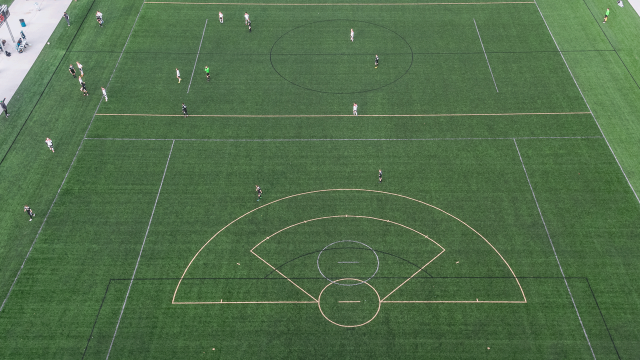
Yes. FieldTurf systems are designed to accommodate multi-sport use on a single surface. We offer custom line inlays, multi-sport layouts and performance-engineered turf systems that support football, soccer, lacrosse, field hockey and more — all on the same field.
Can FieldTurf be installed indoors?
Absolutely. FieldTurf is widely used in indoor training centers, fieldhouses and multi-sport facilities. Our indoor systems are engineered for consistent performance, durability and safety, and can be customized to meet the specific needs of indoor athletic environments.