

More Infill in Turf Linked to Fewer Ankle Injuries in High School Football, 14-Season Study Finds
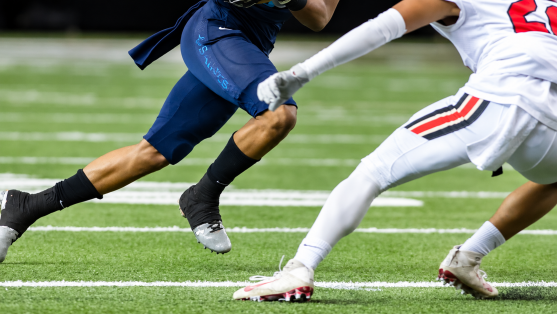
FieldTurf's commitment to “heavyweight” design receives more scientific backing through new research
An eye-opening 14-year prospective study has found that athletes experience a significantly lower incidence of surface-related ankle injuries on playing surfaces with higher infill weight during high school football games. The results, presented in the Orthopaedic Journal of Sports Medicine, were consistent across numerous playing conditions.
As the study’s objective explains, a key motivator for the research was addressing the need for a more thorough investigation:
“With the numerous artificial turf infill systems available, the effect of infill weight on ankle trauma during high school competitive play has not been extensively addressed.”
For this research, artificial turf infill systems were divided into two weight groups based on pounds per square foot: heavyweight (>=9.0 lb./ft2) and lightweight (3.0-6.0 lb./ft2). FieldTurf's high-performance grass-like systems feature an infill design that meets this heavyweight threshold.
As part of this expansive study, researchers tracked 4,275 high school football games across 104 schools in 15 states. 32% of these games were played on heavyweight infill, and 68% were played on lightweight infill. During the research period (2010–2023), 10,509 total injuries were logged, with 1,238 diagnosed as ankle injuries.
The study showed a lower incidence of injury and post-injury medical procedures related to heavyweight infill, per 10-game season, than on lightweight infill across several metrics, including:
- 26% Fewer Total Ankle Injuries
- 46% Fewer Substantial Ankle Injuries (7–21 days lost)
- 20% Fewer Ligament Sprains
- 50% Fewer Distal Tibiofibular Joint Injuries
- 33% Fewer Talocalcaneonavicular Joint Injuries
- 63% Fewer Radiographs Following Ankle Injury
- 70% Fewer Total Imaging + Surgical Procedures Following Ankle Injury
FieldTurf has stood by the effectiveness of our science-backed system design for over 25 years, and these findings build on a long history of evidence supporting that claim. With a reputation for delivering superior results in the lab and on the field, FieldTurf has continued to innovate and set new standards for performance, safety, and durability.
More Evidence for Heavyweight Infill
Complementing the high school research is another recent study presented in Medicine & Science in Sports & Exercise that focuses on ankle joint trauma in NCAA football games across 19 seasons (2006-2024). The study, which included 44 participating universities, compared higher infill weights to natural grass, using the same heavyweight infill threshold (≥9.0lbs/ft2).
Across 2564 games, 49% of which were played on heavyweight infill, 1389 ankle injuries were documented. Compared to natural grass, heavyweight infill surfaces were linked to less severe ankle trauma and fewer post-injury procedures, per 10 games, across several metrics:
- 18% Fewer Instances of Substantial Trauma
- 75% Fewer Instances of Severe Trauma
- 67% Fewer Ligament Tears
- 43% Fewer Instances of Shoe Surface-Noncontact Trauma
- 38% Fewer Injuries to Receivers
- 57% Fewer MRIs
- 67% Fewer Surgical Procedures
Both the high school and NCAA studies were released within a year of the NFL introducing its new enhanced playing surface standard. Developed and approved by the NFL and NFLPA, the standard evaluates each surface using three primary metrics: impact, traction, and infill consistency.
FieldTurf leads the industry in NFL-approved systems, with each designed with heavyweight infill (≥9.0lbs/ft2), emphasizing how our design meets performance standards at every level. The results of the extensive data collection and rigorous testing reflect a core FieldTurf belief: not all turf is created equal.
FieldTurf's heavier infill design is also supported by its status as a leading provider of FIFA Quality Pro-certified systems. With dozens of systems installed around the globe, many of which also meet the heavyweight infill threshold, FieldTurf’s commitment to safety and performance is felt far and wide.
Does more infill weight help reduce injuries?
Yes. The latest studies also complement research from over a decade ago, showing fewer injuries on systems with higher infill surface weight (>9.0 lb./ft2) compared to those at 3.0-5.9 lb./ft2. The study, which focused on head, knee, and shoulder injuries, concluded the following:
“As the artificial infill surface weight decreased, the incidence of game-related high school football trauma significantly increased across numerous playing conditions.”
After more than 25 years of engineering artificial turf systems that perform like elite natural grass and help change the game for athletes, FieldTurf has earned the trust of countless schools and communities in return. Moreover, evidence shows what was true 10 years ago still holds today: heavyweight infill systems are linked to significantly fewer injuries than lighter infill weights. In NCAA play, heavyweight infill can also be associated with less severe ankle trauma than natural grass.
With additional research showing the effectiveness of our approach, we can say more confidently than ever that heavier infill weight helps reduce player injuries. Our proof is in the ground and backed by science.
Explore the research findings here:
The Effect of Artificial Infill Weight on Surface-Related Ankle Injuries During High School Football Games. A 14-Season Prospective Study
Ankle Joint Trauma During NCAA Football Games on Artificial Turf and Natural Grass Surfaces