

Everything You Need to Know About Snow Removal
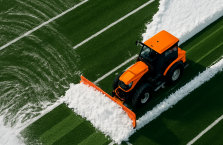
Proper winter care can go a long way in protecting your artificial turf field. By following the right steps, you can extend field use, simplify your spring preparation, and maintain overall performance.
Winter maintenance is more straightforward than it appears—provided you follow the recommended guidelines. Incorrect practices can lead to damage, so always check with your FieldTurf Service Expert if you are unsure. Your FieldTurf team is always here to support.
It is important to note that while the components of your FieldTurf system do not freeze, moisture within the infill does. This frozen moisture allows you to plow the field safely without displacing a meaningful amount of infill.
Follow these steps to properly plow and care for your FieldTurf surface during the winter months:
FALL - STEP ONE: KEEP IT CLEAN IN THE FALL
Properly sweeping and removing debris from the field in the fall will lead to a simpler winter and spring maintenance. Any debris left on the field (leaves or branches for example) can break down over the course of the winter and contaminate your surface.
FALL - STEP TWO: BRUSHING & RAKING
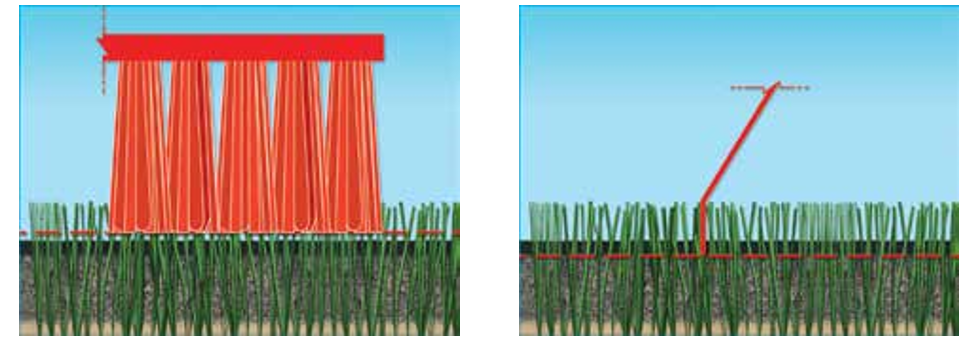
Prior to winter, we recommend performing a brushing session to help lift matted fibers and a raking session to decompact the infill of your synthetic turf surface. Both are recommended after sweeping; in order to ease the drainage process and prevent compaction buildup come spring.
FALL - STEP THREE: PREPARING YOUR EQUIPMENT & SNOW PLACEMENT
It’s key to plan and prepare a dedicated area for snow removal. Preferably, the area is off the surface of play. For plowing, FieldTurf recommends the use of the Turf Pusher by Pro-Tech. Any equipment / vehicle used to remove snow from the artificial turf field should not exert more than 70 PSI (pound-force per square inch) of pressure on the field and subbase. The use of turf tires are recommend.
WINTER – STEP FOUR: PLOW SNOW FROM THE FIELD
The ideal climactic conditions for plowing are always below freezing — FieldTurf recommends a safety threshold of below 25 degrees F and minus -5 degrees C for plowing. Planning snow removal early in the morning or late in the afternoon is preferred.
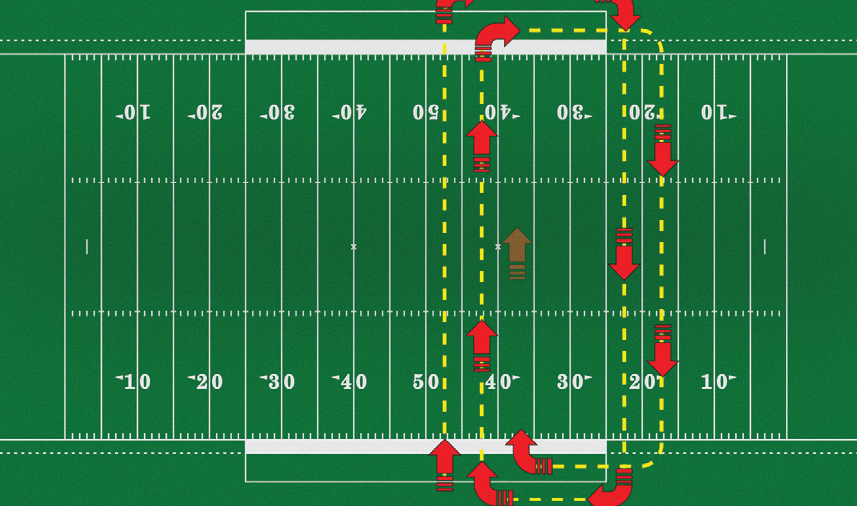
Keep pace with snowfall and regularly plow the field, so the snow and ice doesn’t accumulate and harden. We recommended to plow from sideline to sideline and leave a thin crust of 1” to 1.5” on the surface, which will act as a layer of security. The remaining layer will be melted by the sun.
SPRING – STEP FIVE: FIELD INSPECTION & PREPARATION FOR PLAY
Once the snow and ice is full removed, it’s time to inspect your field’s condition. Examine for potential tears, variation in surface heights and perform infill depth measurements in a variety of spots to ensure infill hasn’t been displaced during plowing. Prior to play perform a sweeping and brushing session.
MOST ASKED QUESTIONS
WHAT ABOUT TARP?
Installing a field tarp is permitted but has demonstrated to cause enhanced condensation and freezing leading to unfavorable results.
CAN I USE ICE MELTERS ON THE FIELD?
The rotating tines on the FieldTurf GroomRight can be used to break up the remaining layer of ice. Proceed with caution using this machine to disturb or remove infill.
If you opt to use a de-icing substance, always test it off the main field of play first to protect the safety of the surface; some de-icing solutions leave a sticky residue behind. The warm brine from calcium chloride solutions, while an effective melting agent, does leave a residue that can affect ball handling, ball reaction and footing.
Calcium chloride solutions, despite the residue potential, are preferred over sodium chloride ones. Magnesium chloride also is acceptable. Aside from any issues with potential corrosion of exposed metal, magnesium chloride won’t harm the turf. Regular salt dries into hard, abrasive crystals that can scuff the fibers. Magnesium chloride, because it picks up moisture from the air, will produce less abrasion.
FieldTurf recommends to flush the field with water to remove potential chemical residue once the outdoor temperature has been above freezing for five consecutive days and the upcoming weather forecast is favorable.
TOTALCARE: COMPLETE FACILITY MAINTENANCE FROM CERTIFIED EXPERTS
Your facility has a lot of moving parts—fields, tracks, courts, fencing, lighting, and more. TotalCare is your expert solution for sports facilities and building maintenance—backed by the team that knows athletic venues inside and out. Our proven expertise in sports construction and surfacing translates directly into smarter, more specialized maintenance for your entire complex—whether we built it or not.
TotalCare’s white-glove approach provides comprehensive support from installation to upkeep. For FieldTurf fields, this can include sweeping and grooming, infill replenishment, GMAX testing, surface repair, home plate and mound maintenance, and much more.
Contact your expert to learn more about how TotalCare provides Total Confidence