
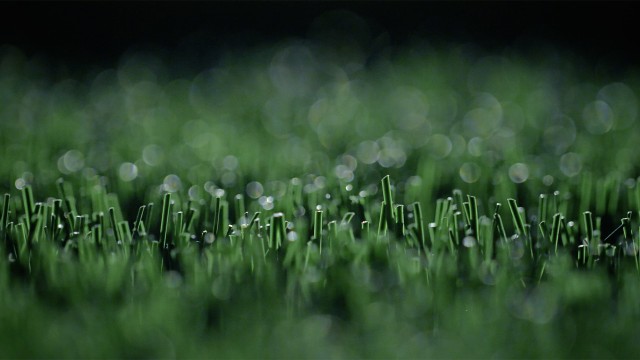
NBC Sports Interview - grass vs. turf debate
Via NBC Sports - Link
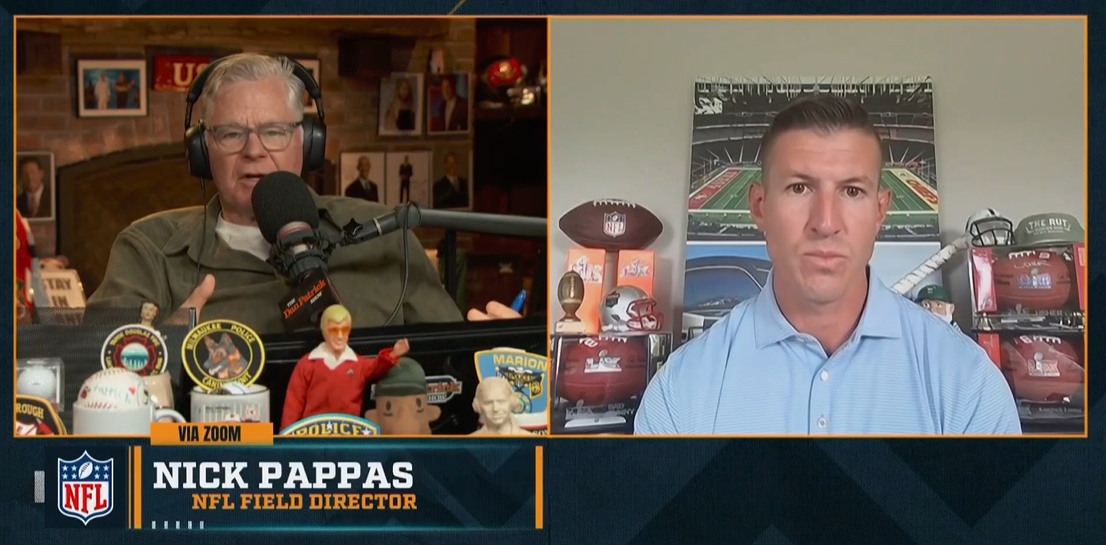
NFL Field Director, Nick Pappas, joined Dan Patrick on NBC Sports for insight into the grass vs. artificial turf debate, advancements in technology to create a friendly surface, and much more.
Watch:
Introduction
Dan: Well, Field Director who joins us on the program, Nick. Good morning. Can you give us an idea? I got your title — what is your job?
Nick Pappas: Morning, Dan. Appreciate you having me on. My job is exactly what it sounds like — manage all things NFL fields. I look at that as overseeing essentially three pillars with the league. One is our game day compliance, which serves all of our regular season games and playoffs — that's at all of our club stadiums, where I support our club field managers. Then there are the tent-pole events — the international games, which continue to expand, the Super Bowl, the Pro Bowl, the upcoming Hall of Fame game, and all those kinds of events. And the last piece is health and research — understanding how we can improve our standards and continue to improve our services.
Dan: How do you become the field director? How do you become an expert?
Nick Pappas: I went to school to learn how to grow grass at the University of Massachusetts, so I have an agronomy degree. Then I started working for different clubs across MLB, MLS, and the NFL. I've been doing it for over a decade now, and I'm fortunate to have made a good career out of it.
Dan: The University of Grass at Massachusetts — I think we should call it that.
MetLife Stadium and Natural Grass
Dan: Help me understand — we've had these beautiful soccer fields, you know, the MetLife lands, which historically has had some issues, I think, with players and that turf. Why can't we keep that grass field there at MetLife?
Nick Pappas: I think the question is bigger than why can't we keep one field in one spot at any given time. It's about how we ensure we develop fields that are going to be right for our purpose, right for the world. What we saw the World Cup do — cheers to them and the team that put things together to ensure a solid tournament — was remarkable, but soccer and football are not apples to apples, and there's a lot to consider when ensuring a surface is right for our NFL athletes.
Dan: But explain that — why would a soccer field not work for the NFL?
Nick Pappas: We've seen this before, especially when we've traveled internationally, and there's nothing that says those surfaces for the World Cup wouldn't have worked — it's just that we don't know they would absolutely work in the same setting, the same climate, the same time of year, and the same way our buildings are used. FIFA took exclusivity of those buildings, and their primary use on those surfaces was just the soccer tournament, which is why we're talking about this now. So the question for the NFL is: could one or two NFL teams play on that surface from August through January, rather than June and July, when the growing conditions and climate are different? Could we understand how MetLife operates as a facility and still make grass work? Those are things that would really have to be looked at, and a big conversation would have to happen to determine if it's possible.
Joint Field Surface Safety and Performance Committee
Dan: The turf itself in some of these fields is newer — I go back to the old days with AstroTurf, which was concrete with carpet on it. With advances in technology, where are we now with trying to make it as close to a friendly surface for these players as possible?
Nick Pappas: We're tenfold beyond where we started with the original AstroTurf product. These infilled 3G-style systems have come a long way, but honestly, I think we're just cracking the surface — no pun intended — on some of this. We've left it to the artificial turf industry to come to us with products, and honestly, the NFL and the NFLPA are really the only groups complaining about these artificial surfaces. We don't hear much of it from the Power Five conferences or the NCAA, and we certainly don't hear much of it at the municipal or high school level. But we're the ones pushing the artificial turf industry, saying we want better — the challenge is quantifying what 'better' actually means. To our benefit, we have what's called the Joint Field Surface Safety and Performance Committee, a committee between the NFL and the NFLPA tied to the collective bargaining agreement, where we sit down regularly to discuss surface improvement. That lets us apply pressure to the industry, define target metrics, define how we're measuring fields, and objectify what 'better' means so we can actually see those changes.
Injury Data
Dan: I'm not sure where you stand on this, but some owners say, 'Look, we have multiple events at our stadium — concerts and so on — so we can't have natural grass.' Is that a legitimate reason not to have natural turf?
Nick Pappas: The way it's been evaluated — when we look across injury data, we no longer see this purely as an injury issue, where turf was thought to drive up the injury rate. When we look at injury rate and severity — ACLs, extended time-loss injuries, the real burden of injuries — it splits out to just the injury rate of playing football at this point, grass versus turf. That's been part of the decision-making: if it's not going to cause more injuries, and it's just as safe, and it gives facilities the opportunity to make good on whatever commitments they have to local communities or however they've decided to operate their building, then it's been a great option, because it allows for higher use and avoids adverse weather conditions. That doesn't mean that won't change — there's an opportunity to ask, from an injury perspective, how we can get it to feel more like the players are asking us to make it feel.
Player Perception
Dan: Talking to Nick Pappas — he works for the NFL as their field director. I'm going to let you pick the stadium where you'd get tackled — what turf surface do you want to be tackled on?
Nick Pappas: I don't want to get tackled by any of these guys — I've seen them all up close. But honestly, and I'm biased here, from mechanical testing on surface hardness, all of our fields are within the same range of compliance. So any given Sunday, Monday, whatever day you want to play, you can pick any field you want. I'm confident the field managers there have ensured it meets compliance, and I don't think one is going to be harder than another.
Dan: So there's no soft landing spot you'd point to — turf or natural grass?
Nick Pappas: I think this is where there's some confusion between what we feel and what's actually being measured. A number of years ago, with the NFLPA, we did a player survey and asked players which fields feel hard and which feel soft. What they told us was actually inverse to what our mechanical testing showed. Based on that, we redeveloped the tools we use to measure fields, and now we understand that what made a field feel 'hard' is really about the amount of energy returned to the body. From a surface hardness perspective, they're all within the same compliance range. What we're chasing now is how to get the amount of energy lost to or returned from the surface to feel more like grass. That's the target now, unless we find an injury correlation, but that's what players tell us they want — to feel more like grass. So that's what we're chasing.
Dan: If you have carpet in your office — do you?
Nick Pappas: I do.
Dan: But not field turf?
Nick Pappas: I don't have any artificial surface in my office. No.
Dan: Or you could have natural grass in there.
Nick Pappas: I could put some grass in here — call it my local sod farm — but it would become more of a full-time job to maintain the surface in my office than it is to sit here and speak with you on these matters.
Field Standards
Dan: So who was your predecessor — George Toma? George Toma was the predecessor to you, and Ed Mangan before, when they used to oversee the Super Bowl — a slightly different role.
Nick Pappas: Yes, sir.
Dan: I was shocked when I went to Lambeau many, many years ago and they were painting grass on the field — they were painting dirt green. What do you make of that, Nick?
Nick Pappas: I don't know exactly how many years ago that was, but our standards have come so far, even over just the last decade. That's the beauty of our joint surface committee — we sit in a room regularly, from the top down, and talk about what matters, how we actually get better, and how we define surface improvement. Player safety is at the top of that list — it's always the North Star. From there, it's about determining how we co-fund and jointly research the meaningful steps we can take toward meaningful change.
Closing
Dan: Great stuff, Nick. Thank you, and good luck with the job. Congrats on all those degrees — what were the degrees you got?
Nick Pappas: I did an associate's degree in turfgrass management through the Stockbridge School of Agriculture, and then a bachelor's in plant, soil, and insect sciences through the University of Massachusetts Amherst.
Dan: Do you judge lawns in your neighborhood?
Nick Pappas: Everyone's but my own. I travel far too much and spend too much time on the road, so I try to keep my job quiet with my neighbors — otherwise I'd be heavily judged.
Dan: Thank you, Nick, we appreciate it.
Nick Pappas: Appreciate it, Dan. Thank you.
Dan: That’s Nick Pappas! He’s a big deal with the NFL – he’s their Field Director.