

No Difference in Heat Stress Between Artificial Turf and Grass
New research concludes that athletes experience comparable heat-related conditions across both playing surfaces.
Quick Read:
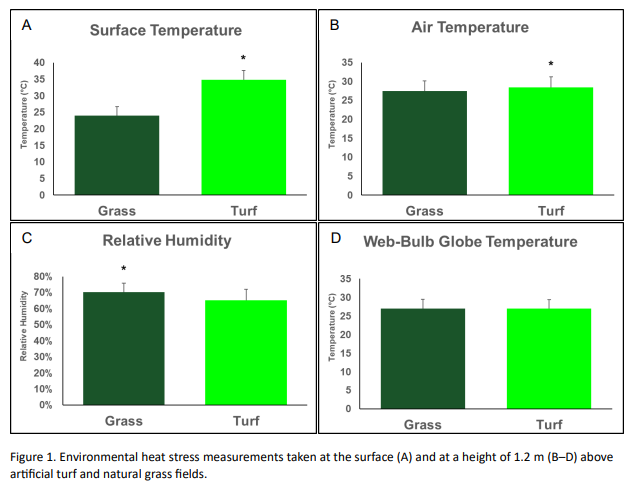
- Despite hotter surfaces, the air temperature athletes experience above turf is only slightly warmer than natural grass - about 1°C (2°F) higher on average.
- Turf’s lower humidity offsets its air temperature, creating similar environmental conditions to natural grass.
- Wet Bulb Globe Temperature (WBGT), the most crucial measure of heat stress, is virtually identical over both turf and grass fields.
- There is no current evidence showing higher rates of heat illness among athletes on turf compared to natural grass.
- Field-surface temperature alone does not determine heat-stress risk; a holistic environmental assessment is essential.
- Study further supports similar conclusions from prior research Evaluation of the Environmental Effects of Synthetic Turf Athletic Fields by Milone & MacBroom in 2008.
When comparing the heat stress that athletes are exposed to when playing on artificial turf to that of natural grass, there is no difference between the two surface types. That is the key finding of a comprehensive study conducted in collaboration between the University of Kansas and the University of South Dakota.
The study, "Comparing Microclimates of Artificial Turf and Natural Grass Fields in Hot Weather," focuses on the risk of heat-related illness, producing results that challenge a common assumption: that athletes face an inherently higher risk of heat illness on artificial turf.
After decades of widespread turf use, there are no known reports documenting higher rates of heat illness on turf than on grass. Current evidence suggests that surface choice alone is not a reliable predictor of heat-related health risks.
Accurately Measuring Heat Stress
While data shows that turf can be warmer than grass on sunny days, the impact is negligible as athletes have limited direct contact with the ground. The air temperature just above the surface, known as the ‘microclimate’, is significantly more relevant to heat stress. This reality also diminishes the impact of popular images, absent proper context, that show infrared temperature guns reading high surface temperatures. By ignoring the microclimate, it’s impossible for these images to tell a complete story.
For a reliable measure of heat stress, researchers looked at the wet bulb globe temperature (WBGT). Considered the gold standard for assessing heat safety, WBGT looks at air temperature, humidity, solar radiation, and other relevant factors. Crucially, the WBGT was found to be nearly identical for both artificial turf and natural grass. According to the study, this may be due to artificial turf retaining less moisture than natural grass, resulting in lower humidity and offsetting higher air temperatures.
To collect these findings, a portable weather station was positioned at a height of 1.2 m (4.0 ft), aligning with international guidelines for heat safety monitoring. Gathered across multiple sessions in the morning, afternoon, and evening, measurements included surface temperature, air temperature, relative humidity, wind speed, and WBGT.
Not only do these results conclude that artificial turf and natural grass maintain similar overall heat stress conditions, it they also complement prior research, Evaluation of the Environmental Effects of Synthetic Turf Athletic Fields by Milone & MacBroom, which reported that artificial turf and natural grass to have nearly identical air temperatures at heights of 5 feet and above. Both past and present research emphasize the importance of considering factors beyond surface-level temperature to gain a more comprehensive understanding of field conditions.
For coaches, athletic trainers, facility managers, and parents, this research provides valuable clarity, emphasizing that heat safety should remain a top priority on all playing surfaces. With that in mind, monitoring WBGT, modifying practices during extreme heat, ensuring hydration, and recognizing early signs of heat illness continue to be the most effective strategies for protecting athletes.
As communities increase access to sports and invest in modern facilities, evidence-based insights like these help ensure that facts rather than misconceptions guide decisions about field surfaces.
About the Testing Conditions
- The field study comparing environmental heat stress on adjacent artificial turf and natural grass fields was conducted during hot weather.
- The turf (baseball outfield) and grass (football) fields were located approximately 275 meters apart at a sports complex in Sioux Falls, SD, with minimal structures or trees to influence conditions.
- Both field locations were located approximately 2 km from a National Weather Service station, which provided reference values for the investigation. Data were collected on days with forecasted highs of 26.7°C (80.0°F) or above, during morning (7:30–9:30 AM), afternoon (1:00–4:00 PM), and evening (6:30–8:30 PM) periods.
- All measurements were taken between July 13 and July 25, 2025.